Overview
The Marangu route’s main highlights include hut accommodation, a gradual and direct path through five ecological zones, and its status as the oldest and most established trail. This route is often called the “Coca-Cola” or “Tourist” route because it provides more comfort with its dormitory-style huts instead of camping. The 6-day itinerary is recommended for better acclimatization, though the shorter duration makes it more challenging in terms of altitude sickness risk compared to longer routes.
Highlights
- Hut accommodation: It is the only route that offers dormitory-style huts
- Direct and gradual ascent
- Diverse ecosystems: Hikers pass through a variety of ecological zones, from lush rainforests to moorlands, alpine deserts, and glaciers.
- Same path up and down: Unlike other routes, the Marangu route ascends and descends along the same path.
Itinerary
Arrive anytime at Kilimanjaro International Airport (JRO). We will arrange a private transfer from Kilimanjaro International Airport (JRO) to Arusha where the rest of the day is at leisure.
We will gather in the hotel where you’ll have an overnight for a pre-climb briefing and an equipment check.
We will also confirm you have the appropriate mandatory medical coverage and travel insurance.
After breakfast, transfer to Marangu gate and start the climb through fascinating rain forest till you reach the first hut Mandara. Meals and overnight at the hut. (9,000ft).
After breakfast, follow the ascending path through the alpine – meadow. The altitude begins to change and slowdown your pace while enjoying the flora and the view of Mawenzi and Kibo peaks. Arrive at the Horombo Hut 12km from Mandara. Meals and overnight at the hut.(12,520ft).
Today we walk towards the Mawenzi hut, passing the Zebra Rocks, this extra day and night at Horombo is for additional acclimatization. We recommend drinking enough water and walking slowly! All meals for the day are provided at the Horombo hut. Horombo hut to further improve our acclimatization.
After breakfast, resume the climb, the landscape becomes rugged and rocky. Lobelias begin to appear. Climb to Kibo Hut.
Meals and overnight at the hut. (15,520ft)
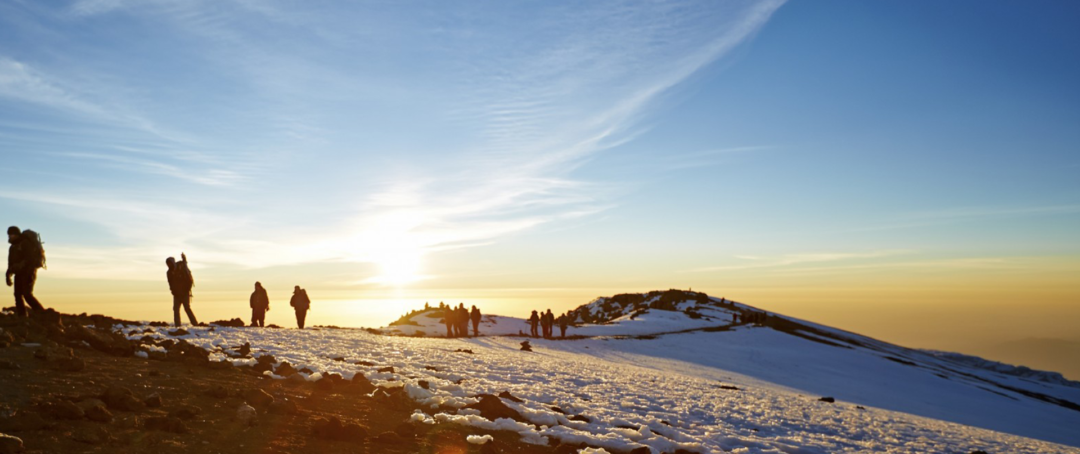
The beginning of the last ascent is made in the wee hrs of the morning while the scree is still frozen. Climb the very steep part of the route to GILMANS POINT (most difficult and tiring part). UHURU PEAK is reached within an hour's walk along the crater rim. (19,344ft). Start the walk along the crater’s rim. (19,344ft). Start the descent to Horombo hut for overnight
Return to your hotel in Moshi. After lunch, have a good rest, meals and overnight at your hotel.
Moshi / Arusha to Kilimanjaro International Airport (JRO) with private departure transfer included.
Cost
The Cost Includes
- Pick-up or Drop-off service from and to Airport(in our own vehicle)
- Transportation to and from!!
- Food all along the trip(Breakfast, Lunch, Dinner and a cup of coffee or tea) and accommodations during the trip in hotels with family environment
- Transportation, food, accommodation and insurance of Guide during the trip
- Down jacket, all-season sleeping bag, duffel bag and trekking map(in case if you don’t have your own. Down jacket, sleeping bag and duffel bag must be returned after completion of the trip)
- First Aid Medical Kit(Your guide will carry the Medical Kit but we also advise to bring yourself for your own use, as far as possible)
- All the required permits and paperwork
The Cost Excludes
- International Airfare
- Visa Charges
- Hotel Expenses(In Kathmandu, some packages do include hotel expenses)
- Your travel and medical insurance
- Personal Expenses such as shopping, bar bills, hot shower, telephone, laundry, titbits etc
- Food and accommodations in Kathmandu
- Services not mentioned or not promised by the agent/agency
- Emergency expenses such as expenses on chartered helicopter.
FAQs
Annapurna Base Camp is a Grade B or a moderately difficult trekking route. So any fit person can do this trek, even if you do not have any previous experience. You should be aware of what to expect and mentally prepare for it. Then, as long as you will too, you can.
On average, you walk about 4 to 6 hours per day. One or two days can be as less as 3hrs and one or two days can be as long as 7hrs.
The highest altitude reached is 4190m. This is the elevation of Annapurna Base Camp. ABC is the highest we will climb in this trek.
Yes, you can charge batteries en route. Charger should be brought. There are hot shower facilities as well. You may have to pay a certain amount for both ($1-$2). Negotiate. Also, a hot water facility could be free at a lower elevation.
No. There are no ATMs on this trek route. You will have to draw enough cash in Pokhara or Kathmandu. There are a number of ATMs in these cities. Everything is paid in Nepali rupees. So money should be exchanged before the start of the trek.
Yes. The Internet can be accessed in most places. Sometimes, there might be some technical problems. The Internet in Nepal is not as fast as you are used to and at times you can just lose connection.
Not really. It depends on you. If you want, ABC trekking can be done independently. You could hire a guide and a porter by yourself instead of going through an agency or not hire a guide at all. Although, not having a guide can be a little problematic during the offseason.
It really depends on you. Is it your first time in Nepal? How confident are you of being able to find your way around? How pressed on time are you? If you go through an agency, it will be costlier but everything will be planned. You will only have to come, trek and return.
For the Annapurna region, pay for guides range from $20 to $30 per day and porters take $15 to $25 per day.